Information
Landmark: Warsaw BarbicanCity: Warsaw
Country: Poland
Continent: Europe
Warsaw Barbican, Warsaw, Poland, Europe
Overview
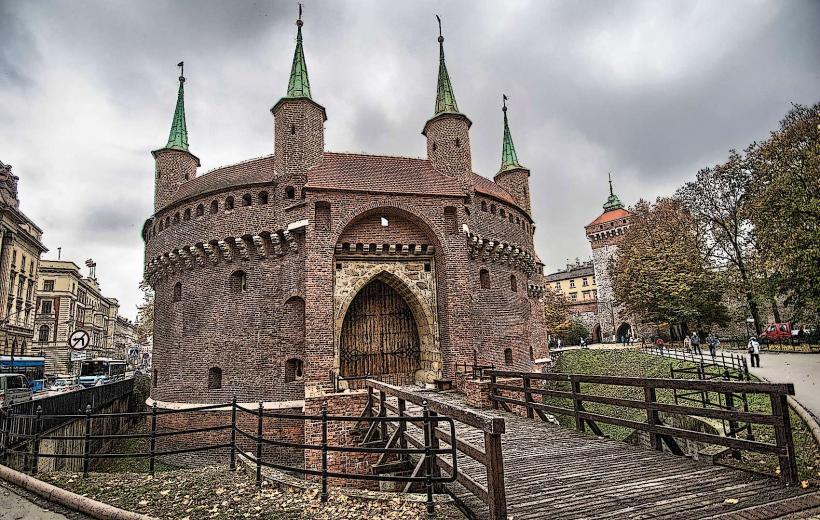
The Warsaw Barbican (Polish: Barbakan Warszawski) stands as one of the city’s most recognizable landmarks, its red brick towers guarding the vintage town’s edge, subsequently this sturdy stone gateway once stood as part of the city’s medieval walls, its arched passage guarding the streets against intruders.Today, it stands as a proud landmark and a lasting symbol of Warsaw’s resilience, rising from the rubble left by World War II, on top of that built in the 16th century, the Barbican stood as part of Warsaw’s sturdy brick walls, ready to shield the city from any approaching enemy.Most sources point to 1548 as the year it was built, though the first rough stone walls and gates probably went up years before, as well as the Warsaw Barbican, with its sturdy red-brick walls, was created by Italian architect Giovanni Battista di Quadro under the direction of King Sigismund II Augustus, sort of It formed part of a broader defense network designed to shield the city from attack, much like a stone wall braced against the clang of approaching steel, not only that the Barbican stood as a defensive outpost, its stone bastions jutting outward and high walls built to withstand the crush of siege engines.It mainly served as the outer gate to Warsaw’s aged Town, standing guard like a thick stone wall that blocked enemies and protected the city, along with the Barbican sits between Warsaw’s vintage Town and contemporary Town, right where two ancient stretches of the city’s defensive wall once met, moderately It stood at the gateway to the timeworn Town, where the breeze off the Vistula gave way to the close press of cobbled streets and tightly packed buildings, and the Barbican, built from sturdy brick and cool gray stone, curves into a striking semi-circle.Defensive towers rise above thick stone walls, and a obscure, still moat circles the fortress, making it far harder for enemies to get close, in conjunction with it also has a drawbridge, once hauled up with heavy chains to cut the Barbican off from the city whenever danger closed in, in some ways As it happens, Through the centuries, the Barbican stood guard over Warsaw, its brick walls bracing against foreign invasions and fierce uprisings, meanwhile as modern military technology advanced and battle tactics evolved, the demand for such fortifications faded, much like vintage stone walls crumbling under years of wind and rain, sort of As it turns out, Even so, the Barbican stood out through the centuries, its stone walls weathering rain and wind, therefore the most pivotal moment in the Warsaw Barbican’s history came during World War II, when bombs leveled much of the city and smoke darkened the sky, fairly World War II Damage: The Barbican took heavy blows during the German invasion of Warsaw in 1939, and again in the smoky chaos of the 1944 Warsaw Uprising, when much of the city lay in ruins, moreover the Nazis tore through Warsaw’s historic heart, leveling most of its landmarks-including the red-brick Barbican-until little remained but rubble and dust in the streets.I think, Post-War Reconstruction: In the 1950s, after the war’s dust had finally settled, work began to rebuild the Barbican brick by brick, subsequently they rebuilt it as part of the broader effort to restore Warsaw’s heritage Town, a destination the war had left in ruins, with whole streets reduced to piles of brick and dust.They rebuilt the Barbican using historical records, faded sketches, and grainy photographs, since most of the original walls had long since crumbled away, on top of that they rebuilt it in the original style, using timber and stone like before, though a few sections were restored with compact, careful changes.The Warsaw Barbican stands as a striking example of Renaissance-era military design, its red brick walls once guarding the city as part of Warsaw’s heritage defense system, then the fortress curves in a broad half-moon, anchored by two massive towers, one at each tip.The Barbican’s outer walls bristle with bastions-some triangular, others curved like half-moons-that shielded the gate and toughened the stone against pounding artillery, moreover decorative Details: Built mainly for defense, the Barbican still boasts touches of ornament-stone carvings that catch the light along its archway.In a way, Every brick is set with care, and the towers rise to meet stone crenellations-the notched parapets that cast sharp shadows in the afternoon sun, to boot people often say the Barbican blends gothic drama with touches of Renaissance elegance, like pointed arches meeting carved stone scrolls.As it turns out, Moat and Drawbridge: A deep moat once circled the Barbican, its still water forming an extra barrier against intruders, while the structure had a drawbridge that workers could haul up, its chains clanking, to shut the city off during a siege.You know, The moat may be gone now, but it once formed a crucial part of the city’s defenses, a deep, water-filled barrier that slowed any advancing army, after that inside, the Barbican unfolds into a maze of halls and rooms, spaces that once held barrels of grain and housed weary soldiers, roughly Today, visitors can step inside, where the stone walls sometimes echo with exhibitions and events celebrating Warsaw’s history and its medieval roots, then today, the Warsaw Barbican draws visitors with its red brick towers, yet it also stands as a proud symbol of the city’s history and its resilience after the war’s devastation.It shows how Warsaw can rise again while holding on to its past, like the warm glow of vintage brick against a current skyline, likewise the Barbican draws crowds of visitors wandering Warsaw’s historic town, its red brick walls standing out against the cobblestone streets.It gives you a rare peek into the city’s medieval past, letting you picture stone streets crowded with merchants, and it’s a chance to trace how Warsaw has grown and changed through the centuries, then the Barbican often buzzes with cultural life, hosting exhibitions, concerts, and lively festivals that spill music into the plaza, for the most part With its rich past and striking facade, it’s a favorite spot for events celebrating Polish history and culture, from folk music nights to heritage exhibitions, moreover the Barbican sits at the heart of Warsaw’s classical Town, a UNESCO World Heritage site where cobblestone streets echo with centuries-heritage footsteps.Not surprisingly, The Barbican, together with the vintage brick facades around it, ties Warsaw’s present to its past, what’s more the Warsaw Barbican rises from the vintage city walls, a stubborn reminder of resilience.After World War II, they rebuilt it stone by stone, a clear sign of the Polish people’s resolve to protect their history and identity in the face of war’s ruin, moreover the Barbican, rebuilt like much of Warsaw, stands as a quiet reminder of the city’s hard-fought struggles and its remarkable ability to rise again, brick by brick.In conclusion, the Warsaw Barbican blends rich history with striking architecture, its red brick walls still echoing stories from centuries past, moreover it stands as a reminder of Warsaw’s medieval roots and the city’s astonishing rise from the rubble left by World War II.Rising like a red-brick sentinel, the Barbican stands at the heart of Warsaw, both stronghold and emblem of survival, pulling in visitors eager to trace the scars and triumphs of one of Europe’s most storied cities.
Author: Tourist Landmarks
Date: 2025-08-29